
 Sadly, for the most part, the gold that was found was alluvial (gold dust) and did not reap the fortune that many were working hard to make. Occasionally a nugget of gold was discovered and though these were few and far between the largest recorded nugget weight a substantial 214 ounces. Stories were spread that alleged nuggets found were as heavy as 25 lbs but are unconfirmed.By the 1880’s most of the prospectors had moved on to pursue their dreams of discovering a fortune in gold elsewhere, and the mining companies moved in with their modern equipment that could dig down deeper for the gold and extract it much quicker than any mere man could. As demand for the gold rose it became obvious to the mining companies that the only way they could increase production effectively was to use electricity, and so two small hydro-electric power stations were built. Soon these became unable to provide the amount of electricity needed so the 2000kW Belvedere station was built in 1911.The Pilgrim’s Rest mines had their most productive years in 1913/14, with an estimated 112000 ounces being mined each year. While that amount seems small in comparison to what could be mined today it was significant for the time, given the equipment and knowledge available, and is a testament to the ingenuity and determination of the mining companies to extract as much gold as they possibly could.
During the Second Boer War (11 October 1899 – 31 May 1902) the town of Pilgrim’s Rest was the location of a mint that was erected under emergency circumstances and the gold mined was used to make what is now the famous and rare Veld Pond coins. Anyone who is in possession or acquires one has the good fortune to not only have a valuable coin but also an integral part of South Africa’s gold mining history.
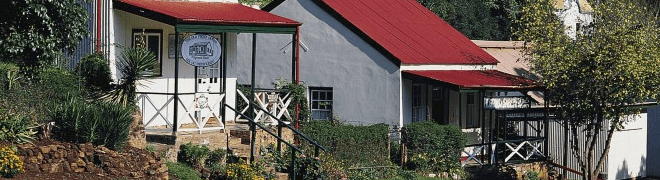
Today the town is a tourist location that takes visitors back in time to the days of the gold rush in the 1870’s. When it first became a tourist attraction in 1970 it was changed very little from its heyday and is now a protected historical site. In 1986 the town was declared a National Monument and since then a concerted effort has been made by curators, historians, architects and other interested parties to ensure the integrity of its history is preserved at all times.
It is said that there is still gold in the ground which is exciting for visitors to contemplate as they stand on the very site where 150 years earlier men, women and children were frantically digging and panning for the elusive solid nuggets that would make them instantly rich beyond their wildest dreams. The scars of the frantic digging for gold by many prospectors are still obvious despite the passage of time, and are just a part of what makes the town unique and interesting.
The South African Gold Panning Association (SAGPA) was founded in July 1997. In August of the same year a delegation from the Association and the Pilgrim’s Rest Museum visited Finland to observe and compete in the Finnish Open Gold Panning Championships. South Africa was also represented at the Swiss Open Championships and the World Gold Panning Championships in Italy. SAGPA also applied for membership of the World Association and became its twentieth member.
SAGPA joined forces with the Pilgrim’s Rest Museum and Mpumalanga’s Department of Culture, Sport and Recreation to successfully present the first annual South African Open Gold Panning Championships in December 1997. Interest in gold panning has since grown rapidly and membership of the association has grown by 620%. Participation in the South African Open Championships has also grown remarkably and a record number of 567 gold panners competed in the 2004 event. The South African events have also drawn competitors from Great Britain, Caribbean Islands, United States, Canada, Mozambique, Botswana, Switzerland, New Zealand, Zambia and Namibia.


Every year since 1997 SAGPA has been represented at the World Gold Panning Championships, the highlight being the 2001 championships in Australia. Apart from the gold and silver medals that were won the South African contingent also succeeded to secure the bid to host the 2005 World Gold Panning Championships at Pilgrim’s Rest, Mpumalanga, South Africa. Not only is this a first for South Africa but a first for Africa.
The town is a tourist location that takes visitors back in time to the days of the gold rush in the 1870’s. When it first became a tourist attraction in 1970 it was changed very little from its heyday and is now a protected historical site.